Author Recent Posts Syed Muhammad Hamza Latest posts by Syed Muhammad Hamza (see all) Legal Commentary on the Recent Decision on the Indus Waters Treaty – October 14, 2026 Underlying Factors for the Mecca Joint Defence Agreement – August 28, 2026 Can National Security Override International Water Treaties? A Legal Analysis of India’s Suspension of
The recent decision of the Court of Arbitration at The Hague concerning the Indus Waters Treaty (IWT) is legally significant because it addresses whether a state can unilaterally suspend a binding treaty because of terrorism, national security concerns or changing circumstances. On 31 August 2026, the Court held that the 1960 Treaty remains fully in force and that India’s decision to place it in “abeyance” had no legal effect. This raises two important questions: can security concerns justify suspending treaty obligations, and how effective is an international ruling when one party rejects the tribunal’s jurisdiction?
The dispute arose after India announced in April 2025 that it was placing the IWT in abeyance following the Pahalgam attack in Indian-administered Jammu and Kashmir. India linked the attack to cross-border terrorism and accused Pakistan of supporting it, while Pakistan denied involvement. India argued that its decision was justified by national security concerns and that the Treaty could not continue normally while such security threats existed. The Court therefore had to examine whether these circumstances created a legal basis for suspending the Treaty.
The terrorism issue was particularly important because India sought to connect its security concerns with its treaty obligations. The Court, however, distinguished between the alleged terrorist activity and the legal obligations created by the IWT. The Treaty governs the use and allocation of the Indus river system and establishes mechanisms for resolving water-related disputes; it does not regulate terrorism or impose obligations concerning cross-border security. The Court therefore concluded that the circumstances relied upon by India did not provide a legal basis for unilaterally suspending the Treaty.
This reasoning is significant because it demonstrates that a serious deterioration in relations between two states does not automatically suspend their treaty obligations. If security disputes could independently justify suspension of unrelated treaties, states could potentially avoid international obligations whenever bilateral relations deteriorated. The decision therefore reinforces the separation between political disputes and legal obligations. While terrorism and national security remain serious matters, their existence does not necessarily provide a legal right to disregard a separate treaty unless international law specifically permits such action.
India also relied on the argument that circumstances surrounding the Treaty had fundamentally changed since 1960. These included population growth, changing water requirements, climate change, developments in technology and the increasing importance of hydroelectric power. India argued that these developments had altered the conditions under which the Treaty was originally concluded. The Court rejected this argument, finding that the changes relied upon did not fundamentally transform the nature of India’s obligations under the Treaty.
The Court’s reasoning is closely connected with the principle of pacta sunt servanda, under which treaties in force are binding upon their parties and must be performed in good faith. The IWT contains no provision allowing either India or Pakistan to unilaterally suspend or terminate the Treaty. Therefore, India’s description of the Treaty as being in “abeyance” could not itself create a new legal status. The decision consequently reinforces the principle that unilateral political declarations cannot automatically remove obligations created under international law.
The issue of sovereignty also formed part of India’s broader position. India argued that matters concerning its national security and sovereign decision-making could not be subjected to the Court’s determination. The Court nevertheless treated the question of treaty obligations as a matter governed by international law. The decision does not prevent India from exercising its sovereignty; rather, it confirms that the exercise of sovereignty remains subject to international obligations that India has voluntarily accepted through treaties.
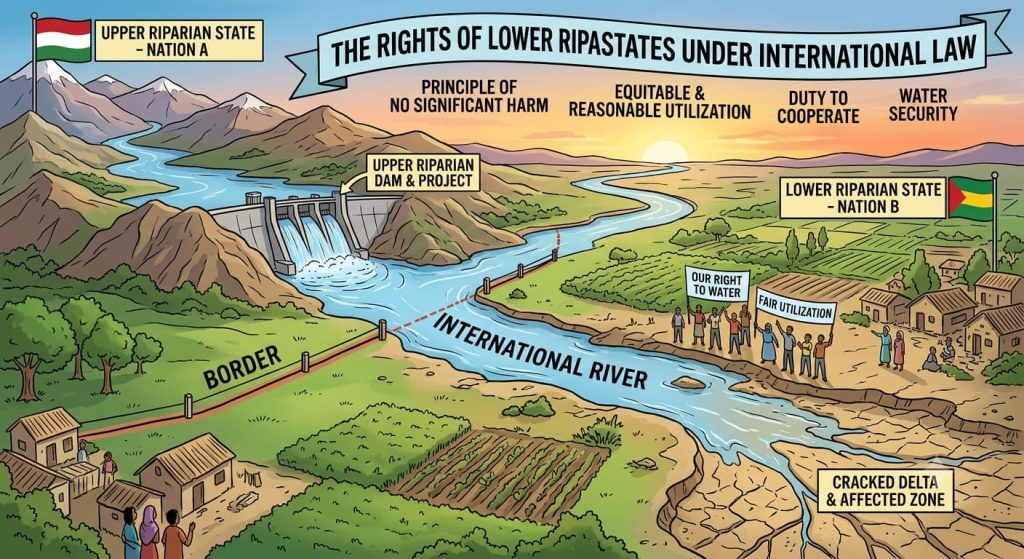
The decision is also important because of the Court’s interim measures concerning India’s Ratle Hydroelectric Plant on the Chenab River. The Court restricted certain construction activities pending the Neutral Expert’s final decision on the project’s compliance with the Treaty. These measures are significant because the IWT permits India to use the Western Rivers for specified purposes while recognising Pakistan’s rights over those rivers. The Ratle dispute therefore demonstrates how the Treaty has direct consequences for Pakistan’s water security.
However, the decision also exposes an important weakness in international dispute settlement: the difference between legal authority and practical enforcement. India did not participate in the arbitration proceedings and has rejected the Court’s jurisdiction, describing the tribunal as illegally constituted. India has also maintained that its decision to place the Treaty in abeyance remains valid. This creates uncertainty over whether the Court’s conclusions will translate into actual compliance on the ground.
The situation therefore raises a broader question about the effectiveness of international law. An international tribunal can determine the legal obligations of states, but it does not possess the same direct enforcement mechanisms available to domestic courts. The Court’s decision may strengthen Pakistan’s legal position, but it cannot by itself guarantee that India will change its policy. The effectiveness of the ruling will consequently depend partly on diplomatic pressure, continued engagement and the willingness of both states to use the Treaty’s established dispute-settlement mechanisms.
The decision should therefore be understood as more than a dispute over water. It concerns the relationship between treaty law, national security and changing circumstances. By rejecting unilateral suspension based on terrorism and other security-related arguments, the Court has reinforced the stability of treaty obligations. At the same time, India’s rejection of the ruling demonstrates the practical limits of international adjudication when a state disputes the authority of the tribunal.
In conclusion, the 31 August 2026 decision represents an important development in international treaty and water law. It confirms that terrorism, national security concerns, sovereignty and changing circumstances do not, in this case, provide a legal basis for India to unilaterally suspend the Indus Waters Treaty. Nevertheless, the dispute shows that establishing what international law requires is only one part of the problem. The more difficult question is whether international law can ensure compliance when political and security tensions between states remain unresolved.

- Legal Commentary on the Recent Decision on the Indus Waters Treaty - October 14, 2026
- Underlying Factors for the Mecca Joint Defence Agreement - August 28, 2026
- Can National Security Override International Water Treaties? A Legal Analysis of India’s Suspension of the Indus Waters Treaty - July 15, 2026