Author Recent Posts Eeshah Fatima Latest posts by Eeshah Fatima (see all) Article 239 of the Constitution of Pakistan: Amending the Amendable – September 30, 2026 The Anti-Terrorism (Amendment) Bill, 2026 – September 30, 2026 Pakistan’s New Defence Command Structure, Explained: What the 2026 Act Changes – September 15, 2026
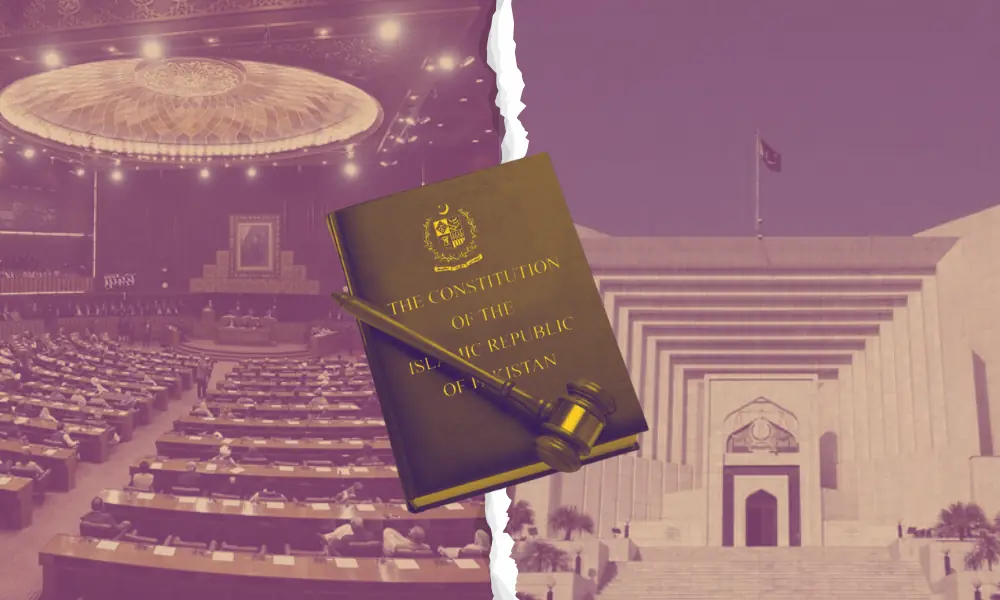
Article 239 of the Constitution of Pakistan forms the constitutional amendment provision, whereby Parliament can make changes to the very constitution that has provided it with its powers. No other constitutional provision has had as much controversy associated with it. This is because it lies at the junction of two conflicting constitutional doctrines: Parliamentary Sovereignty and Constitutional Supremacy.
The procedure is straightforward: a Constitution Amendment Bill may originate in either House and must pass with a two-thirds majority in both the National Assembly and the Senate. Amendments altering provincial boundaries additionally need two-thirds approval from the affected province’s assembly, as with the 2018 FATA merger vote in Khyber Pakhtunkhwa. Once passed by both Houses, the bill goes to the President for mandatory assent. Article 239 also includes an ouster clause, barring courts from questioning amendments on any ground and declaring Parliament’s amending power unlimited.
The history of Article 239 itself is a reflection of this very power, because this provision has itself been amended many times. It had a different formulation when first enacted in 1973, and it was restrictive in nature. Under the Revival of the Constitution of 1973 Order, 1985, during the period of martial law under General Zia-ul-Haq, Article 239 was rewritten, enabling an amendment bill to be moved in both Houses and not just in the National Assembly, while including the provision of judicial immunity from any such amendments made to the Constitution and declaring the amending power of Parliament to be unlimited. That order briefly required approval by every provincial assembly for any constitutional amendment, a requirement withdrawn later the same year, leaving provincial approval necessary only for amendments touching provincial boundaries.
The Constitution (Twenty-seventh) Amendment Act, 2025 left the amendment procedure unchanged but revised the judicial-review clauses. It reworded the ouster provision to bar courts from questioning any amendment “on any ground whatsoever,” notwithstanding anything in the Constitution or prior judgments. This is widely read as reinforcing the earlier Zia-era bar by closing off possible exceptions. The same amendment also restructured the judiciary, creating a new Federal Constitutional Court. This was a contested move criticised by the UN High Commissioner for Human Rights as hastily adopted without broad legal consultation, while supporters described it as a governance modernisation effort.
The ouster clause raises an obvious question courts have returned to repeatedly: if amendments cannot be questioned on any ground, does the judiciary have any role in policing the amending power? Mahmood Khan Achakzai v. Federation of Pakistan, challenging the Eighth Amendment, is treated as introducing basic-structure reasoning into Pakistani law. It holds that Parliament could amend any provision so long as federalism, parliamentary democracy, and Islamic provisions remained untouched, formally leaving amending power unrestricted while finding implied limits. Pakistan Lawyers Forum v. Federation of Pakistan engaged this idea further but declined to strike anything down. This reflects a recurring pattern of acknowledgment without action.
The most extensive modern treatment came in District Bar Association, Rawalpindi v. Federation of Pakistan, the Eighteenth and Twenty-first Amendment case, examining whether military courts trying civilians were constitutional. By thirteen votes to four, the Court held that Article 239’s clauses still left room for some judicial review. Earlier cases were cited, including Nadeem Ahmed v. Federation of Pakistan, and concluding courts had recognised the basic-structure idea only as identifying salient features. Even so, it did not strike down the amendment. Chief Justice Nasir-ul-Mulk dissented, arguing the doctrine’s foundations were weak, tracing much of it to a passing remark in Achakzai.
Petitioners relying on the basic structure theory to challenge the military courts were ultimately unsuccessful. The Court reaffirmed that neither the Objectives Resolution nor the Preamble carries overriding legal force capable of displacing a validly passed amendment. Cases in the Al-Jehad Trust line take the contrary emphasis, holding that no constitutional provision can be struck down merely for being inconsistent with another. This is because resolving such conflicts belongs to Parliament, not the judiciary. Commentators trace this debate’s roots further back to Fazlul Quader Chowdhry v. Muhammad Abdul Haque in 1963, later cited by India’s Supreme Court in developing its own basic structure doctrine.
Taken together, this body of case law reveals two threads that a fair account has to hold at once. On one hand, courts have repeatedly entertained the argument that some feature of the Constitution, whether federalism, parliamentary democracy, Islamic provisions, or judicial independence, might lie beyond Parliament’s reach even with a two-thirds vote, despite the express language of Article 239. On the other hand, no Pakistani court has yet actually annulled a constitutional amendment on that basis. Pakistani courts have consistently distinguished their own position from India’s, with the salient-features language functioning more as an interpretive caution than as an operative power of invalidation.
Those who favour a stronger judicial role argue this leaves fundamental rights and institutional balance exposed to a determined two-thirds majority. Those who favour Parliament’s plenary amending power point to the explicit text of Article 239. They argue that Articles 238 and 239 reflect a deliberate constitutional choice to vest amending power solely in the elected legislature rather than the courts. The 2025 tightening of the ouster clause can be read as the legislature reasserting that latter view in more explicit terms, after years of judicial hedging on the question. Though critics see the same move as narrowing an important check at a moment when other amendments were also reshaping the judiciary’s structure and powers more broadly.
A useful example of Article 239 operating exactly as designed, rather than as a subject of doctrinal dispute, is the Twenty-fifth Amendment of 2018. It merged the Federally Administered Tribal Areas into Khyber Pakhtunkhwa. Because this altered a province’s territory, the bill required the additional step of provincial assembly approval. It passed the Khyber Pakhtunkhwa Assembly by eighty-seven votes to eighty-three, clearing the required two-thirds threshold, before receiving presidential assent the following day. A purely national two-thirds majority would not have been sufficient on its own. This is precisely the safeguard Article 239’s boundary provision was written to provide.
Article 239 embodies a deliberate constitutional design: a demanding two-thirds threshold in each House, with provincial consent for boundary changes, paired with an express attempt to shield outcomes from judicial scrutiny. Pakistani courts have spent nearly three decades probing that insulation. They were able to recognise a theoretical basic structure without ever striking down an amendment on that ground. Parliament, most recently in 2025, has tightened the ouster language further meanwhile. Whether a two-thirds majority should face any judicial check remains, as settled doctrine, an open question in Pakistani constitutional law, even as the text itself moves decisively toward reinforcing parliamentary primacy.

- Article 239 of the Constitution of Pakistan: Amending the Amendable - September 30, 2026
- The Anti-Terrorism (Amendment) Bill, 2026 - September 30, 2026
- Pakistan’s New Defence Command Structure, Explained: What the 2026 Act Changes - September 15, 2026