Author Recent Posts Syed Muhammad Hamza Latest posts by Syed Muhammad Hamza (see all) Underlying Factors for the Mecca Joint Defence Agreement – August 28, 2026 Can National Security Override International Water Treaties? A Legal Analysis of India’s Suspension of the Indus Waters Treaty – July 15, 2026 Evaluating Islamabad MOU through the prism of
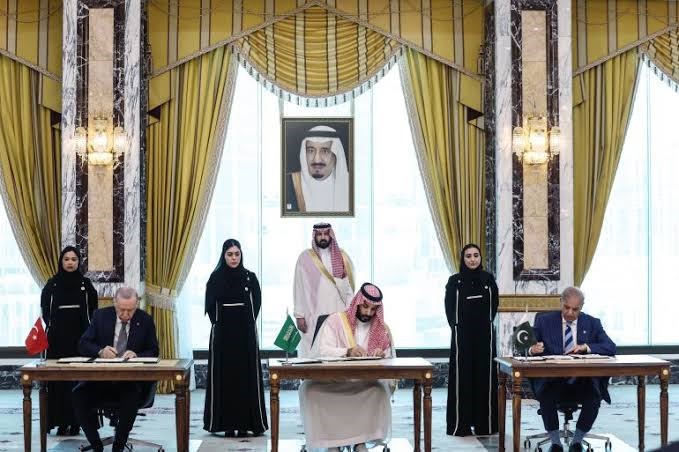
The Mecca Joint Defence Agreement between Pakistan, Saudi Arabia and Türkiye is the result of several converging strategic, economic and security factors rather than a response to a single regional threat. Growing instability in the Middle East, uncertainty surrounding existing security arrangements, Saudi Arabia’s search for greater strategic autonomy, and the expanding defence cooperation between Pakistan and Türkiye have created the conditions for this new security partnership. The agreement must therefore be understood against the wider transformation of the regional security environment, particularly the growing importance of energy security and the vulnerability of maritime trade routes.
The immediate background to the agreement is the deterioration of regional security. Prolonged conflict involving Iran, attacks on regional targets, and disruptions to commercial shipping have increased concerns among Gulf states about the reliability of existing security arrangements. The Strait of Hormuz has become particularly important in this context. Its disruption has demonstrated how quickly regional military tensions can affect energy supplies, international shipping and economic stability. The agreement’s commitment to collective defence therefore provides its members with an additional mechanism for deterrence and security cooperation.
Saudi Arabia’s desire to strengthen its security partnerships is another important factor. Riyadh has traditionally relied heavily on the United States for its security, but recent regional developments have encouraged Gulf states to diversify their strategic relationships. The Mecca agreement allows Saudi Arabia to strengthen ties with two significant military powers while maintaining its existing international partnerships. Pakistan provides considerable military capabilities and longstanding experience in Gulf security, while Türkiye contributes a major defence industry, NATO experience and increasingly advanced military technology. The agreement can therefore be viewed as part of Saudi Arabia’s broader effort to develop greater strategic autonomy rather than relying on a single security partner.
Energy security adds another important dimension. Saudi Arabia’s economic relationship with Asian energy markets has become increasingly significant as the United States has become less dependent on Middle Eastern crude. Saudi oil exports to Asia, particularly to countries such as China and India, remain strategically important. However, supplying these markets depends heavily on maritime routes vulnerable to regional instability. The recent disruption of the Strait of Hormuz has already forced Saudi Aramco to explore alternative methods of supplying Asian refiners, including rerouting crude through the Red Sea and arranging deliveries outside the Strait.
This creates a direct connection between energy and defence. Saudi Arabia is not only concerned with protecting its territory; it also has to protect the infrastructure and maritime routes through which its energy exports reach international markets. The Strait of Hormuz and the Red Sea are therefore economic as well as military concerns. A prolonged disruption can increase shipping costs, threaten energy exports and create uncertainty for major Asian customers. The development of stronger security relationships with Pakistan and Türkiye consequently provides Saudi Arabia with additional strategic depth at a time when the security of regional trade routes has become increasingly uncertain.
Pakistan also has important interests in the agreement. Pakistan and Saudi Arabia have maintained close military and economic relations for decades, and their relationship was formalised further through the Strategic Mutual Defence Agreement signed in 2025. The 2026 Mecca agreement expands this security relationship by bringing Türkiye into a trilateral framework. For Pakistan, this provides an opportunity to strengthen its strategic position in the Middle East, deepen defence cooperation with Türkiye, and maintain its longstanding relationship with Saudi Arabia. Pakistan also has a direct economic interest in Gulf stability because of its dependence on energy imports, trade links and remittances from Pakistani workers in the region.
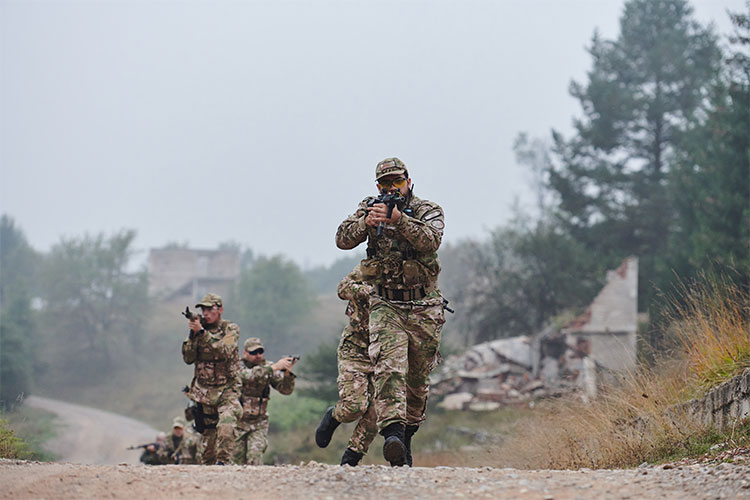
Türkiye’s participation reflects its growing regional role. Ankara has developed a substantial indigenous defence industry and has expanded its military and diplomatic engagement across the Middle East. The agreement provides Türkiye with an opportunity to strengthen its relationships with both Pakistan and Saudi Arabia while increasing its role in regional security. The planned cooperation covers land, maritime, air and cyber domains, alongside areas such as unmanned systems, electronic warfare, artificial intelligence and joint defence production. This indicates that the agreement is not simply a political declaration but also has a significant defence-industrial dimension.
Iran is also an important part of the strategic environment surrounding the agreement, although the pact is officially presented as defensive and does not identify Iran as an adversary. Saudi Arabia has faced security concerns connected to Iranian missile and drone capabilities and Iran-aligned groups operating across the region. At the same time, Pakistan and Türkiye have their own relationships with Iran and are unlikely to view regional security entirely through a confrontational lens. This makes the agreement more complex than a straightforward anti-Iran alliance. Its broader purpose appears to be strengthening the members’ collective ability to respond to a deteriorating security environment while increasing their strategic room for manoeuvre.
Ultimately, the Mecca Joint Defence Agreement reflects a changing regional security architecture. Its foundations lie in the convergence of regional instability, Saudi Arabia’s search for diversified security partnerships, Pakistan’s strategic relationship with the Gulf, Türkiye’s expanding defence role, and the growing importance of protecting energy and maritime trade. The agreement therefore represents more than military cooperation between three states. Its long-term significance will depend on whether these countries can translate their political commitment into effective intelligence sharing, joint military capabilities, maritime security cooperation and defence-industrial collaboration. If successful, the agreement could become an important component of a more independent regional security framework; if not, it may remain primarily a powerful symbol of changing geopolitical alignments.