Author Recent Posts Eeshah Fatima Latest posts by Eeshah Fatima (see all) Two Articles, One Province: Power of Federal Governor Rule Explained – November 18, 2026 Pakistan’s Strongest Weapon on the Afghan Front Is Law – November 18, 2026 The Saudi-Houthi Conflict: Background, Timeline, and What It Means for Pakistan’s Defense Commitments – November 11,
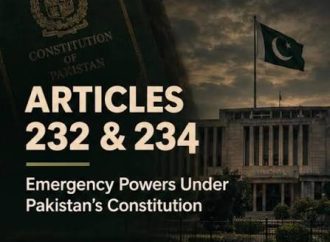
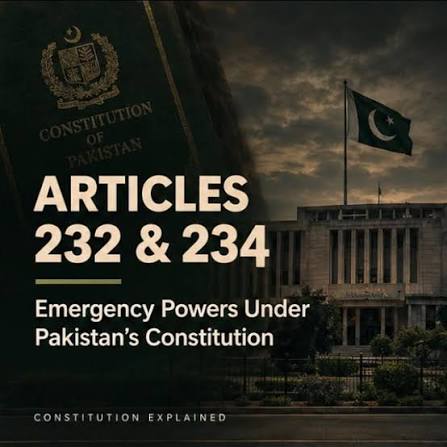
Articles 232 and 234 of the Constitution are Pakistan’s emergency brakes, but they are different brakes, and the government has pulled both at once in Khyber Pakhtunkhwa. On 11th October, the President, on the Prime Minister’s advice, proclaimed an emergency and governor’s rule in the province, displacing its elected government. The two provisions have separate triggers, separate time limits and separate consequences, and using them together blurs accountability. So what does each article permit, what limits bind them, and can Parliament or the courts meaningfully check a decision of this magnitude?
Under Article 232, the President can proclaim a state of emergency in case the security of Pakistan or of any part thereof is endangered owing to war, external aggression, or internal disturbance which the government of the province cannot control. The use of the expression “any part thereof” implies that the emergency does not have to apply to the entire nation. Upon making such a proclamation, the executive can issue directions on how the province exercises its authority, and Parliament can pass laws for the provincial areas. Article 233 separately permits suspending certain fundamental rights, though reports say the summary signed by the President did not invoke it.
In Article 234, a distinct situation is provided for, where it deals with the malfunctioning of the constitutional machinery of a province. The President, on receipt of the report of the Governor or otherwise being satisfied that it would not be possible to carry on the administration of a province according to the provisions of the Constitution, can take over or direct the Governor to take over the duties of the provincial government and can declare that the powers of the provincial legislature shall be exercised by or under Parliament. Its test is narrow: constitutional breakdown, not political disagreement or poor administration.
The duration of the two articles varies significantly. The governor’s period as stipulated by Article 234 has a maximum of six months, after which the powers of the provincial assembly reappear. Even if the Federal Minister of Law says otherwise, this will not necessarily resurrect the elected government. The duration of the emergency under Article 232 has no time limit and ends only when the situation is lifted. This is precisely the crux of the matter. There is a limited power along with an unlimited one.
Parliamentary approval is the first mechanism for checks and balances. The Constitution has made it mandatory that a proclamation of emergency must be presented before Parliament at definite intervals, and this time the National Assembly, followed by the Senate and then joint sessions, has approved it. The government’s defense is that it has fulfilled its constitutional obligation through this process. The opposition points out that the vote of a parliamentary majority is an act of politics but no assurance that the conditions have been fulfilled. A fair question follows: if the ruling coalition both advises the proclamation and ratifies it, what independent check does Parliament supply?
The second safeguard, judicial review, is where the dispute becomes more intense. The provisions of Article 236(2) make it clear that the legality of a proclamation made under this Part will not be challenged in any court, and supporters argue that, with Article 48(2), this is an almost insurmountable obstacle. Opponents counter that ouster provisions do not apply to actions that are done outside the jurisdiction and in bad faith, as per the judgment of the Supreme Court of Pakistan in Leghari’s case. It is clear that the constitutional requisites – an actual emergency and actual breakdown – must be present. A petition would likely begin in the Peshawar High Court and could reach the Federal Constitutional Court.
Then there is the question of combining the two articles. Article 232 is a security emergency, while Article 234 is a constitutional breakdown, and each needs its own factual foundation. Textually, nothing prevents governor’s rule from preceding a separate emergency, but it must be noted that Article 234 cannot be used simply to create the conditions for Article 232. Some question why both were invoked together when their requirements differ. The government says worsening militancy and governance breakdown justified both.
The stakes extend beyond one province. The 18th Amendment strengthened provincial autonomy, and an emergency that places an elected provincial government under federal direction tests that settlement directly. The federal government says it has no wish to hold the province indefinitely. Opponents say the move displaces an elected government led by a party now in opposition at the centre, and point to Balochistan, where terrorism continues without comparable federal action. Both claims can be examined against the record: what correspondence preceded the decision, and what material did the cabinet actually consider?
Whatever one’s politics, a few tests are reasonable. First, evidence: the government should be able to show how militancy exceeded the province’s capacity, and how provincial machinery actually failed, not merely that cooperation was imperfect. Second, proportionality: powers under Article 232 should be used only as far as the threat demands, perhaps in specific districts rather than the whole province. Third, time: the emergency should be reviewed regularly and revoked once its purpose is served.
Articles 232 and 234 exist because no constitution can assume every crisis will resolve itself politically. They were written as exceptions, with stated conditions, parliamentary approval and, in the case of Article 234, a time limit. Pakistan’s history with extraordinary powers has produced differing views on where the balance lies. Supporters of the federal action point to the security situation and the approval Parliament gave. Critics point to the constitutional conditions and the question of judicial review. How the courts and Parliament handle those arguments in the coming weeks will shape how these provisions are read in the future.

- Two Articles, One Province: Power of Federal Governor Rule Explained - November 18, 2026
- Pakistan’s Strongest Weapon on the Afghan Front Is Law - November 18, 2026
- The Saudi-Houthi Conflict: Background, Timeline, and What It Means for Pakistan’s Defense Commitments - November 11, 2026