Author Recent Posts H.M Umar Farooq Latest posts by H.M Umar Farooq (see all) The Rights of Lower Riparian States under International Law. – August 4, 2026 A broader Regional and Muslim Unity: Lessons from the Gulf Crises – August 4, 2026 The Future of US-Iran Relations – August 4, 2026
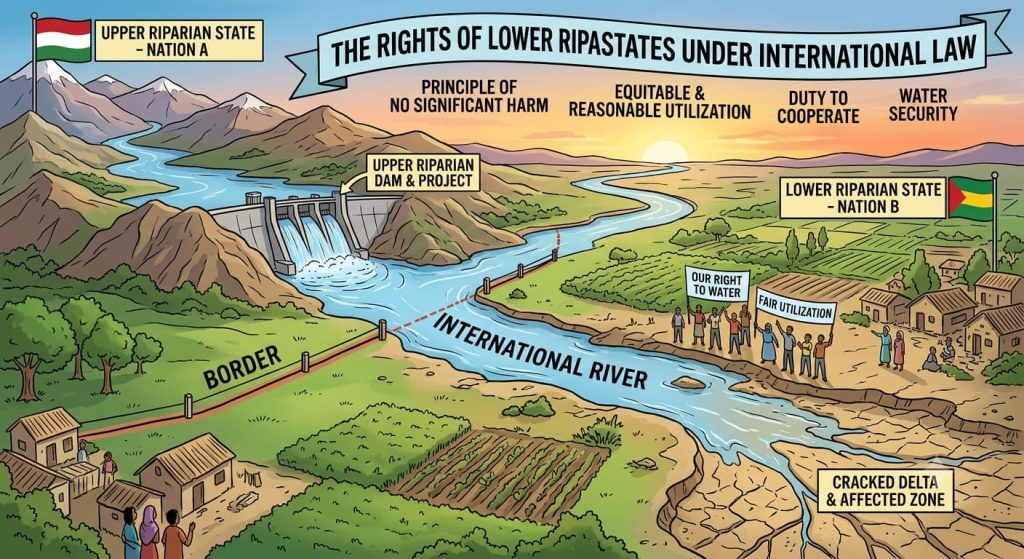
International law guarantees riparian states the right to equitable and reasonable utilisation of shared watercourses and protection from significant transboundary harm. Water is crucial to sustaining life, as its disruption can result in significant economic and humanitarian crises, potentially escalating to armed conflict. Hydrological geography determines whether a State is an upper or lower riparian, thereby defining the rights, obligations, and limitations applicable under international water law.
Indus river is the largest river in the South Asia originating from Chaina. In the hierarchy China stands at the top as an upper Riparian States to India and Bangladesh. Whereas India is an upper riparian state to Pakistan being a lower riparian state. Nepal and Afghanistan also fall within the status of riparian state however, they pose no threat to regional security as their control over the downstream is minimal when compared to others.
The water role is critical factor in determining the geography and geopolitics of the region. Indus River is heavily dependent on glacial melt from the Himalayas. Climate change is accelerating glacial retreat, leading to flooding, reduced dry season flows and increased transboundary tensions. Therefore, conservation of the third pole is essential. Mostly all the rivers that are derived from Himalayan region are among the 10 most endangered rivers globally.
These rivers impose responsibilities on their respective country to respect other countries rights of water access, and that when the Indus Water Treaty (IWT)1960 was signed between India and Pakistan which is an historic pact for sustaining life. India, as a mid-riparian state, has the responsibility to act as a stabilising force. Therefore, it is required from it to maintain equitable relationship with both upper and lower riparian state to avoid conflict and promote peace.
Therefore, Duties and human right consideration are imposed on the upper riparian state. Under the United Nation Watercourses Convention (UNWC) 1997, upper riparian states are obliged to follow the rule as per the international water courses. This imposes an obligations not to cause significant harm and to act as an equitable and reasonable neighbour. India’s dams must not harm Pakistan’s water security under UNWC. Although India has had not ratified UNWC, however its principles are considered customary international law and are therefore binding on all states, regardless of ratification. These instruments collectively affirm the obligations of riparian states to prevent significant transboundary harm, ensure equitable and reasonable utilisation of shared watercourses, and duty to cooperate.
These articles are relatively important when it’s come to Pakistan rights as an lower riparian state. Indus water treaty is not just a treaty for Pakistan instead it’s a lifeline for more than 240 million people. Pakistan 90% agricultural economy is based on irrigation and energy security which is entirely dependent on river flows originating from upstream countries like India.
Pakistan’s rights as a lower riparian state is violated by India in several ways, these instances include the building of dam and hydropower projects which grant India control over the timing of water flows while violating IWT that imposes binding obligation on India to duty to cooperate even when the treaties are suspended under UNWC Art 8; UNECE Art 2, 3. Further, India’s refusal of sharing data and Information violates UNWC Art 9, 12 which requires india to notify Pakistan of planned projects. India’s aim to maximize use of the Western Rivers and threats to divert water flows by depriving Pakistan’s population from human right to water which is recognised by UNGA Ressolution 64/292.
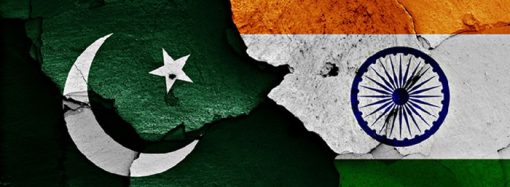
India’s position as an upstream state gives it control over flows to Pakistan, creating existential concern for Pakistan. In February 2019 after Pulwama attack India threatened to cut of water supply to Pakistan. Also, in April 2025, after the Pahalgam attack in Jammu and Kashmir, Pakistan was blamed and India threatened that they will suspend IWT. Pakistan considered this statement as an act of war due to its existential concern and its right to water under treaties and international law. The water war has a domino effect and would have led to significant agricultural, energy, and humanitarian crisis for Pakistan.
Suspension of the IWT could reduce water flow to Pakistan and cause damage to its irrigation system. Degradation of water quality or ecosystems by India violates the UNWC Art 20-22. The principle of equitable and reasonable conduct requires India to balance its needs with Pakistan’s dependence on water under article 5 of the UNWC 1997, and article 6 of the UNWC. The international watercourses must exercise their rights consistently with the principles of equitable utilisation and environmental protection as affirmed by the International Court of Justice in 1997 in Gabcikovo-Naymaros Project.
International water law protects the rights of lower riparian states with the principles of equitable and reasonable utilisation, prevention of significant transboundary harm, and the duty to cooperate. These obligations are effective, and cannot be avoided by treaty disputes and remains part of the customary international law. Therefore, any unilateral measure which causes harm to the water security of Pakistan or any other country is incompatible with the principles of international water law, therefore it important to comply with these laws, regulation and treaties or else it could led to an escalation undermining peace and security of the region.

- The Rights of Lower Riparian States under International Law. - August 4, 2026
- A broader Regional and Muslim Unity: Lessons from the Gulf Crises - August 4, 2026
- The Future of US-Iran Relations - August 4, 2026