Author Recent Posts Wajeeha Ashfaq Latest posts by Wajeeha Ashfaq (see all) How has the Middle Eastern War Transformed the Iran-Gulf Relations? – July 15, 2026 Will Water Emerge as the Next Battlefield between India and Pakistan? – July 15, 2026 The U.S.-Iran Peace Process and the Lebanon Question – July 15, 2026
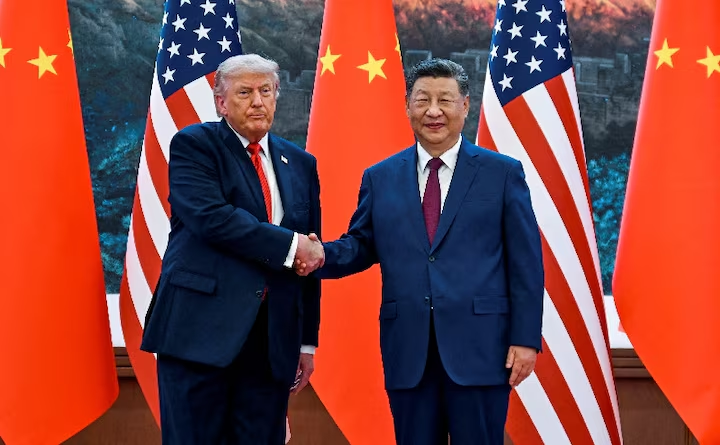
The US President’s visit to China marks a new era of détente and strategic cooperation, given that the two global powers interact through constructive engagement. This has been the first visit after Trump’s 2017 visit to China, which signifies the aspiration of escaping the Thucydides’ Trap from both sides. Both leaders have discussed multiple issues; however, no decisive results have been reached yet, or at least, announced by both sides clearly. Trump has announed several trade deals and an affirmation of cooperation from Xi Jinping on Iran. But China has not clearly mentioned any such arrangement in its official statements. A huge contradiction has been observed between both sides, which raises speculations over the lasting cooperation. Can a global hegemon and a revisionist power actually manage to escape the adverserial positions and become partners in the long run?
Trump’s visit to Beijing highlighted a reality that both Washington and Beijing now reluctantly accept: Neither side can afford a complete rupture, even as mistrust grows across every major strategic issue. Both leaders came out of the summit looking for stability after months of tariff escalation and economic uncertainty. Trump boasted pledges of Chinese purchases of Boeing aircraft, soybeans, energy products, and agricultural goods, in a bid to soothe domestic industries affected by the trade war. Xi, alternatively, projected China as a dependable economic partner but avoided detailed public commitments. The difference between the two sides was considerable. Washington emphasized on commercial “wins” and market access; Beijing was more concerned with the broader picture of “strategic stability”.
Iran’s issue also points to another stark difference in priorities. The White House was eager to present China as increasingly aligned with Washington’s pressure campaign on Tehran, especially amid the crisis surrounding the Strait of Hormuz. Beijing, however, steered away from endorsing any US-led security framework or criticising Iran. Instead, China called for efforts to achieve a lasting ceasefire, dialogue, and a political settlement. Xi presented China as a stabilizing power, not a party to coercive diplomacy. This distinction is important. China relies heavily on Gulf energy supplies and has little incentive for a military escalation that could threaten global markets. At the same time, it is reluctant to back any US strategy that could increase American influence in the region or damage its own relations with Tehran.
Taiwan remains a decisive factor in determining the fate of US- China relations in the long term. Xi Jinping asserted that Taiwan is the most sensitive issue in China-US relations and warned that mishandling it could lead to a direct confrontation. Trump’s remarks aboard Air Force One reflected both caution and ambiguity. By saying he did not want the United States to “travel 9,500 miles to fight a war,” he signaled reluctance toward military entanglement. However, willingness for any concrete concessions on arms sales to Taipei remains unclear. For Beijing, that ambiguity may be preferable to open confrontation, but it also reinforces fears that Washington could continue using Taiwan as a bargaining chip in broader strategic negotiations. Simultaneously, Beijing may utilize the pressure of Iran’s war on Trump as a card to cut off the US support to Taiwan to achieve its ultimate goal of ‘national rejuvenation’. The situation remains, however, unclear and dependent on Trump’s strategy towards Taiwan.
The summit also revealed how much the balance of leverage has shifted in recent years. Trump arrived in Beijing weakened by domestic political pressures, legal setbacks to his tariff agenda, and the broader fallout from the Iran crisis. China, by contrast, entered the talks from a comparatively stronger position, buoyed by its rising exports, dominance in rare earth minerals, and growing technological self-sufficiency. Xi did not try to proclaim a blatant display of triumph, which points towards China’s belief in the need for coexistence as partners in peace. The aim is to avoid war through the use of strategic patience in advancing their national interests rather than any direct conflict.
The outcome of this meeting was an agreement between both nations to pursue mutually beneficial objectives through negotiation. As it stands right now, there are still unresolved trade disputes, Taiwan issue, and major ideological differences regarding Iran and global security. Both leaders gracefully acknowledged that engaging in open conflict, economically or militarily, would create catastrophic consequences for the entire international community. Therefore, this summit reflects a significant understanding between both about the nature of the relationship between them. Neither side wishes to end coexistence or collaboration, despite a considerable level of competition.

- How has the Middle Eastern War Transformed the Iran-Gulf Relations? - July 15, 2026
- Will Water Emerge as the Next Battlefield between India and Pakistan? - July 15, 2026
- The U.S.-Iran Peace Process and the Lebanon Question - July 15, 2026