Author Recent Posts Abubakar Saeed Latest posts by Abubakar Saeed (see all) INDUS WATER TREATY AND ITS LEGACY – July 17, 2026 IRAN’S FROZEN ASSETS AND NUCLEAR ISSUE:REFRAMING OF US-IRAN REALTIONS – July 17, 2026 THE FUTURE OF PAKISTAN INDIA RELATIONSHIP – June 24, 2026
Rivers and their water, historically, have remained a red line for almost every civilization. Access to water has always been essential for ancient settlements. In today’s modern times, things remain largely unchanged. In almost every part of the world, there is an issue linked to either oceans, seas, or rivers. The subcontinent, after its independence from the British, gave birth to two new adversaries, Pakistan and India, which have had continuous confrontations over water. In the first few years of partition, both Pakistan and India had concerns on how the waters in the Indus basin will be shared. Pakistan felt threatened by the Indian control over the Indus Basin, whereas India, on the other hand, had her ambitions for the profitable development of the basin. For the management of these waters, Standstill agreement was signed followed by Inter-Dominion Accord of May 4, 1948, which required India to release sufficient water towards Pakistan through existing canals, in return for an annual payment from the government of Pakistan. The accord was followed by more negotiations to reach a permanent solution to this issue. Indus water treaty came into effect in September 1960, reaching a permanent solution. The path to this treaty was long and complex, involving years of negotiations, with the assistance of the world bank. This treaty is considered as the most successful treaty ever signed between two countries. It provides a comprehensive framework for collaboration and effective sharing of water.
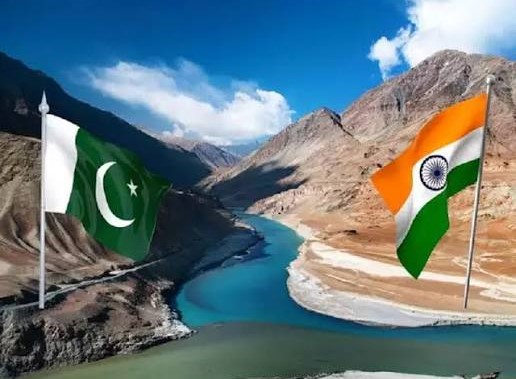
The Indus River originates in the Tibetan Plateau. Passing through China, India, and Pakistan, it empties in the Arabian Sea. Indus water treaty provides a mechanism of cooperation between Pakistan and India, regarding their use of the rivers in the Indus river system. This treaty divides the 6 rivers of Indus River System into two parts; three eastern, and three western rivers. Eastern rivers came into the share of India. These rivers include; river bias, Ravi, and Sutlej, which have an annual flow of 33 million acre-feet, comprising 20% of the total discharge of Indus river system. Western rivers, river Indus, Chenab, and Jhelum, came into the share of Pakistan. These rivers have an annual flow of 135 million acre-feet, which is almost 80% of the total discharge of the Indus river system. This treaty allows India for unrestricted use of the eastern rivers, whereas it legally permits Pakistan for unrestricted use of her share of the rivers. This treaty allows both to construct storage dams, hydropower projects, and diversion canals on their share of the rivers. As western rivers also pass through India before entering Pakistan, this treaty also restricts India to the limited use of these rivers. India cannot construct storage dams or disrupt the flow of the rivers. It can only utilize it for non-consumptive uses such as fishing and navigation. In contrast, India keeps violating these terms from time to time. This treaty is of great significance when considering the future of bilateral relations.
India’s actions undermine the significance of the Indus Water treaty, therefore negatively affecting the bilateral relations. The Permanent Indus Commission (PIC) is a vital organ of this treaty. It is a bilateral body which includes representatives from both India and Pakistan, established to oversee and ensure the effective implementation of the treaty. Its primary role was to provide a platform for cooperation. However, India’s actions have raised questions about the effectiveness of the Permanent Indus Commission. After the 2016 Uri attack, India decided to indefinitely suspend the meetings of the commission. Furthermore, despite having a legal framework that forbids unilateral amendments, withdrawal, or abeyance, this treaty saw some recent developments. In April 2025, following terrorist attack in Pahalgam in Kashmir, India decided to unilaterally hold in abeyance the treaty with Pakistan. This decision by India is illegal and against the essence of the bilateral treaty. Following this illegal decision, India also attempted to stop the flow of the river Chenab. Pakistan, however, has warned India, that any attempt to disrupt the flow of western rivers by India, would be considered an act of war. To this date, the treaty remains suspended unilaterally, creating an environment of mistrust, and possible direct confrontation.
Pakistan claims that it is the right of its people on these waters. It is illegal to hold this treaty in abeyance or unilaterally suspend it. Furthermore, water is a lifeline, and a redline for Pakistan. Pakistan has also warned India that if it attempts to disrupt the flow of the western rivers, key Indian infrastructure on these rivers will be targeted. Additionally, India needs to maintain the legacy of the Indus water treaty and respect the bilateral agreement. It needs to realize the importance of this treaty in bilateral cooperation. If this treaty gets its due respect, conditions between two neighbors can improve, promoting trans-border trade and cooperation. Both countries should work together to solve their issues through dialogue and understanding rather than conflict. This will help build trust between the two nations and create a better future for their people. Good relations can also encourage more cooperation in different areas and reduce tensions in the region. This will be a significant development in the south Asian region; making it a peaceful and stable region. In this way, the Indus Water Treaty can continue to play an important role in promoting peace, stability, and cooperation in South Asia.

- INDUS WATER TREATY AND ITS LEGACY - July 17, 2026
- IRAN’S FROZEN ASSETS AND NUCLEAR ISSUE:REFRAMING OF US-IRAN REALTIONS - July 17, 2026
- THE FUTURE OF PAKISTAN INDIA RELATIONSHIP - June 24, 2026