
Author Recent Posts Eeshah Fatima Latest posts by Eeshah Fatima (see all) Article 239 of the Constitution of Pakistan: Amending the Amendable – September 30, 2026 The Anti-Terrorism (Amendment) Bill, 2026 – September 30, 2026 Pakistan’s New Defence Command Structure, Explained: What the 2026 Act Changes – September 15, 2026
The recent transfer of IHC Justices Mohsin Akhtar Kayani, Babar Sattar, and Saman Rafat Imtiaz has stirred up a debate over judicial independence versus administrative authority. The government frames these moves as efficiency-driven adjustments under Article 200, however, legal critics question the impact on constitutional protections. The question surfaces: does this use of discretion indicate a commitment to court optimization, or does it ultimately redefine the traditional security of judicial tenure?
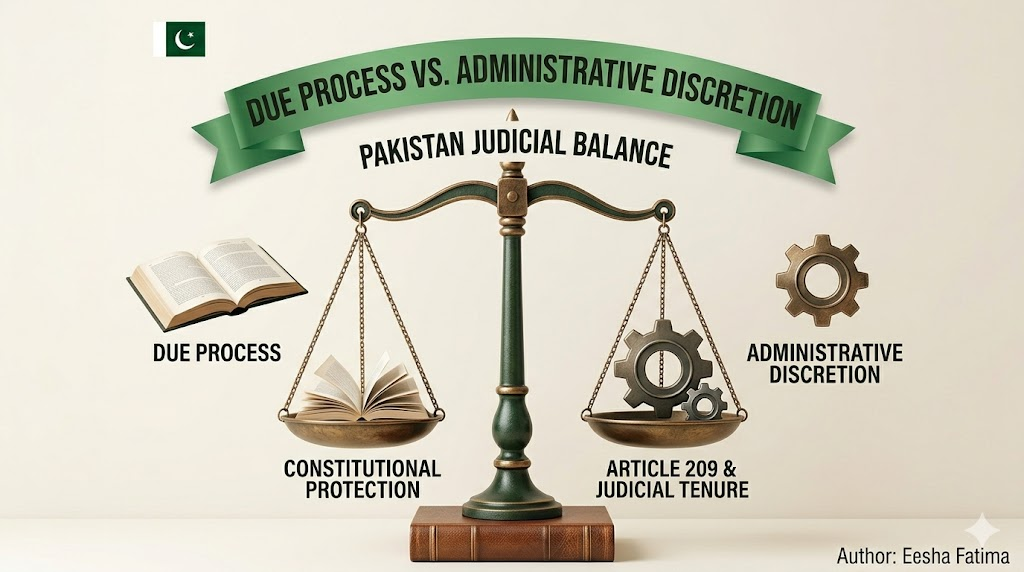
The core of the controversy rests on the interpretation of two constitutional provisions. Under the amended Article 200(1), the state now has the authority to transfer judges without their consent. The concern arises that this mechanism may circumvent the protections established in Article 209.
Judges may face disciplinary proceedings for refusing these transfers, and thus legal observers have raised questions about the use of administrative discretion. The concern is that, without a clearly defined set of objective criteria for reassignments, such actions could be interpreted as a substitute for formal removal procedures or perceived as punitive measures during periods of institutional tension.
Article 209 forms the basis of judicial security, establishing the Supreme Judicial Council (SJC) as the exclusive, constitutionally mandated forum for evaluating judicial conduct. By requiring a structured, quasi-judicial inquiry, it provides judges with the cardinal protection of due process. Thus, ensuring that removal is never based on executive whim, but rather on proven incapacity or misconduct. This “gold standard” of accountability is designed to shield the judiciary from external pressure, guaranteeing that tenure is secure.
26th and 27th Amendments have introduced structural changes to judicial governance in Pakistan. By centralizing the authority to transfer judges through the Judicial Commission of Pakistan (JCP), these updates have adjusted the process for judicial reassignments.
The 26th Amendment (2024) instituted a three-year tenure for the Chief Justice, created Constitutional Benches, and added parliamentary representation to the JCP. The 27th Amendment (2025) introduced the Federal Constitutional Court (FCC), provided legal immunity to the President and high-ranking military officers, and authorized the JCP to transfer judges without their consent. While these amendments are regarded by the state as reforms to enhance democratic accountability and efficiency, they have also been characterized by legal observers as a tethering away from the traditional tenure protections established under Article 209.
Distinctions exist between the procedures for formal judicial inquiries and administrative transfers. While the SJC follows an evidence-based inquiry process, transfers involve greater administrative discretion and typically involve less public documentation. This procedural difference has led some observers to question whether such reassignments prioritize workload management or influence judicial independence. Supporters consider these amendments imperative to reduce case backlogs and curb judicial overreach. Rather than a punitive tool, judge transfers are labelled as administrative measures to ensure experienced jurists are strategically positioned where they can most effectively enhance court efficiency.
The transfer of these judges is subject to two primary interpretations. Officially, the government and the JCP categorize the moves as administrative reassignments under the 27th Amendment, intended to optimize “resource management” and improve court efficiency by strategically positioning experienced jurists. However, legal observers and bar associations point to the judges’ history of institutional friction as evidence that the transfers may be a response to their judicial independence and oversight of executive authority.
The three judges were among the six IHC judges who reported external interference in judicial affairs and previously questioned the appointment of Chief Justice Sardar Sarfraz Dogar. Justice Babar Sattar is a noted legal analyst, while Justice Saman Rafat Imtiaz has been involved in high-profile committee matters regarding judicial conduct. Justice Mohsin Akhtar Kayani is recognized for his human rights jurisprudence and his public reservations regarding the 27th Amendment.
These developments represent a repositioning in the constitutional balance, where administrative discretion progressively replaces formal procedural bulwarks. Such a trend naturally raises questions regarding the future of judicial insulation and the fluid nature of institutional independence.
Proponents on the other hand, emphasize that these transfers are necessary for a comprehensive strengthening of the provincial circuit in order to ensure that top-quality judicial expertise does not concentrate on one bench, but rather extends its influence to cover backlogs. These transfers amount to an effective use of the provisions of the 27th Amendment to make sure that the judiciary applies consistent judicial standards across the country. This process also helps overcome stagnation in fixed appointments.
The transfer of judges nevertheless has an effect on the court’s operations. The commission reported that proposals to transfer Justice Arbab Tahir and Justice Khadim Hussain Soomro were withdrawn by the members who initially requested them. Additionally, the commission decided by majority that vacancies resulting from transfers would be filled through further internal transfers rather than new appointments. This policy represents a shift in judicial resource management and impacts the court’s established succession procedures.
These reallocations also affect judicial dockets, as the transferred judges were overseeing various active cases. The change could result in procedural delays for pending litigation even though a new roster has been implemented to manage the transition. Members of the legal community, including the IHC Bar Association, have voiced that these transfers may impact judicial morale. It is also suggested that if reassignments are perceived as being based on factors other than merit, it could affect public perception of the court’s impartiality and institutional legitimacy.
Supporters of the transfers deduce that the inclusion of parliamentary representation within the JCP foments democratic accountability, aligning the nation with international models where the legislature oversees judicial appointments. Plus, the creation of Constitutional Benches is deemed as an incumbent structural reorganization to separate complicated political questions from routine litigation, thereby increasing overall judicial efficiency and ensuring that specialized legal matters receive dedicated expertise.
The current judicial transformation mirrors an acute antagonism between administrative modernization and institutional autonomy. As legal challenges proceed, the resolution of this conflict will likely hinge on whether the judiciary establishes clear, objective criteria to govern the use of administrative discretion under the 27th Amendment.
The future stability of Pakistan’s constitutional balance may depend on whether these new mechanisms are viewed as tools for institutional reform or as shifts in the boundaries of judicial autonomy. Will these structural changes succeed in cultivating a more accountable and efficacious legal system, or will they intrinsically alter the landscape of judicial independence for future generations?

- Article 239 of the Constitution of Pakistan: Amending the Amendable - September 30, 2026
- The Anti-Terrorism (Amendment) Bill, 2026 - September 30, 2026
- Pakistan’s New Defence Command Structure, Explained: What the 2026 Act Changes - September 15, 2026