Author Recent Posts Eshrat Fatima Latest posts by Eshrat Fatima (see all) Is Pakistan emerging as a new middle power? – June 24, 2026 Can Economics Bridge the Divide? Trade Relations under Modi’s India – June 16, 2026 Transit of Goods Order 2026: The Legal Road to Regional Integration – May 14, 2026
The Transit of Goods Order 2026 is not merely another dry piece of legislation; but potentially a masterclass in using commercial law as a diplomatic scalpel. Pakistan is mitigating the unpredictability of the Strait of Hormuz and leveraging its location as a lucrative asset by establishing an essential land corridor for products from foreign countries to reach Iran. The state is sending an authoritative message to the global market during a period of elevated regional tensions: we are the region’s economic linchpin, not just a dot on a map. Is it not a testament to Pakistan’s strategic foresight that it is transforming its geographic location into a geopolitical shield and an economic engine?
The SRO 691(I)/2026, which was issued under the Imports and Exports (Control) Act, 1950 and in accordance with the 2008 Pakistan-Iran agreement on international transit of passengers and products by road,has come into effect.
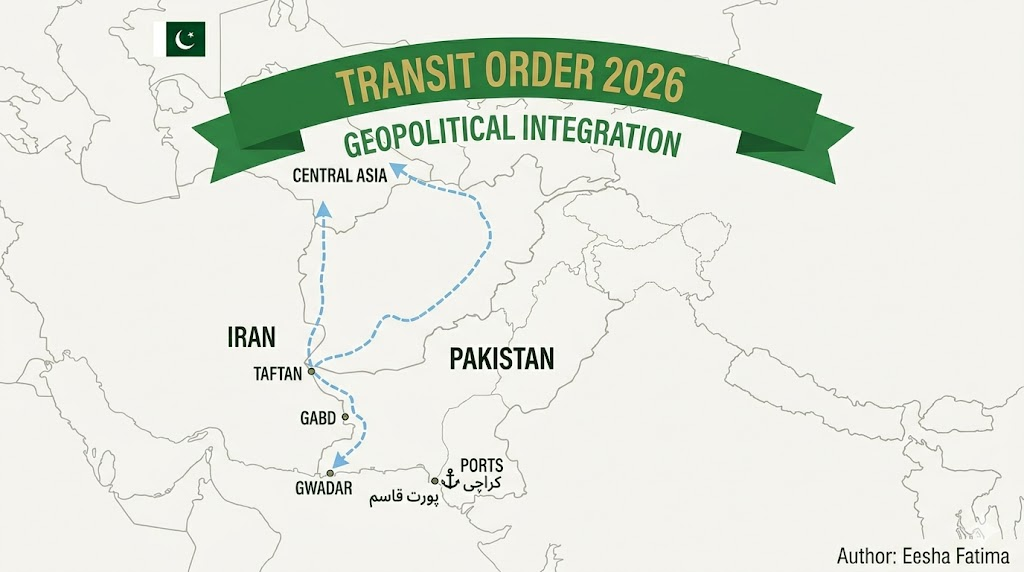
The Act defines important logistics concepts including “cross-stuffing,” “customs security,” and “transit transport corridors.” In order to expedite the transit of commodities consigned from third countries across Pakistani territory to Iran, it particularly defines six important routes, including corridors connecting Gwadar, Gabd, Karachi, and Taftan. These goods are solely meant to be moved across Pakistan under close supervision; they are not intended for sale in the region. The Customs Act of 1969 governs all operations under this notification, ensuring that transit trade complies with the security and procedural requirements set forth by the Federal Board of Revenue.
The primary objective of the Transit of Goods Order 2026 was to position Pakistan as an indispensable land bridge for regional trade during a time of unanticipated maritime instability. The order permits commodities to be transported from international markets into Iran and Central Asia under stringent customs monitoring by formalizing transit channels and “cross-stuffing” procedures at ports like Gwadar and Karachi.
By eschewing the standard reliance on sea routes, this change was intended to turn Pakistan’s geographic location into a strategic economic asset. It would prevent the “leakage” of untaxed commodities into the local economy and generate income through logistics services and transit fees. In an era of fluctuating global alliances, can Pakistan afford to be anything less than a regional hub?
The effective blockage of the Strait of Hormuz in early 2026 due to a “dual blockade” including regional conflict and ensuing international naval constraints served as the geopolitical impetus for this order. Shipping traffic slowed down, maritime insurance costs surged, and the world’s most important oil and cargo chokepoint was frozen in place. As a formidable “safety valve,” the 2026 Order permitted goods to pass through land corridors like the Taftan border and arrive in Pakistani ports outside of the crisis area. By successfully separating regional trade from the unstable Persian Gulf maritime environment, this land-based alternative proved to be imperative for the security of food and energy in the region.
A marked shift in national strategy is represented by the Order, which adopts a constructive “geo-economic” model in lieu of the conventional border-security orientation. Pakistan is essentially incorporating a service-provider structure to its geography by formalizing these corridors, which enables the state to generate capital from logistics and infrastructure without inherently owning or purchasing goods that are in transit.
Six main routes are activated by this “land-bridge” concept, which connects the Iranian border at Taftan and Gabd to the deep-sea ports of Karachi, Port Qasim, and Gwadar. Pakistan facilitates smooth, containerized movement that can avoid the congested Suez Canal by incorporating these routes into the International Road Transport (TIR) system, providing a transit time to Europe via Turkey that is noticeably quicker than standard maritime shipping.
Pakistan is also undergoing a strategic paradigm shift, owing to the Order, by diversifying its trade corridors to Central Asia and reducing the historical over-reliance on the Salang Pass in Afghanistan. Although Afghanistan is the shortest geographic link, Pakistan decided to move away from such dependence owing to border closures in Afghanistan. The new legislation helps bypass the Afghan borders and makes use of the Iranian border crossing points Taftan and Gabd for transporting the goods from Pakistani sea ports of Karachi and Gwadar to Uzbekistan, along with other Central Asian states and the Caucasus.
It can be said that the legislation employs Commercial Law as a clever diplomatic “shield” that goes beyond pragmatic aspects. Pakistan ensures that transit remains a heavily regulated, professionalized commercial activity by codifying processes like “Cross-Stuffing”; where items are shifted between containers or transport modes, and mandating encashable financial guarantees equal to local duties. Plus, by addressing the financial and physical loopholes that formerly enabled transit cargo to be “leaked” into local markets, the order also tackles smuggling, mainly via the financial guarantee system.
An estimated Rs 750 billion in lost tax revenue from smuggling and illicit trade is drained from Pakistan’s national treasury annually, posing a major threat to the country’s financial stability. Now, thanks to the Order, bank guarantee or insurance bond equal to the total import duties and taxes that apply in Pakistan must now be submitted by traders. This basically renders unauthorized diversion goods as costly as a regular import and eliminates the profit motive for smugglers by assuring that the government may promptly recoup the revenue lost if goods fail to leave the country at the specified border points.
The government also makes it more straightforward for the FBR and law enforcement agencies to locate and stop any vehicle that veers off course by directing all transportation heading toward Iran through these high-surveillance routes. The usage of “ghost routes” or isolated desert tracks, which have historically been utilized to get around customs inspections and transport goods illegally around the province, is restricted under this “corridor-only” policy.
The law offers foreign shippers a stable and predictable environment by establishing a “neutral corridor” that may operate without interference from local political unrest. By replacing informal trading with a legitimate system that demands the participation of domestic customs brokers and transportation companies, it successfully professionalizes the border and guarantees that the monetary benefits are derived locally.
The statute translates Pakistan’s geographical location into a dependable source of revenue denominated in US dollars. The country establishes a “Transit Economy” that augments foreign exchange reserves by imposing infrastructure tolls and transit fees, as well as promoting the use of Pakistani logistics and insurance companies.
This concept takes its inspiration from global hubs such as the Suez Canal or Singapore, where the value is determined from the efficiency of the passage rather than the actual cargo. The increased volume of trade assists to subsidize national infrastructure. This makes the entire regional supply chain more accessible for both Pakistani exporters and foreign partners, as Karachi and Gwadar stand out as the preferred gateways for landlocked Central Asian Republics and surrounding markets.
In defining such surveillance-intensive corridors, Pakistan turns its geography into a weapon for making a security liability into a strength by building a logistics economy that will secure the national treasury while protecting regional trade from the vagaries of the sea route. With the disruption to the global supply chain at unprecedented levels, is Pakistan not the only logical anchor for a stable, land-based future?

- Is Pakistan emerging as a new middle power? - June 24, 2026
- Can Economics Bridge the Divide? Trade Relations under Modi’s India - June 16, 2026
- Transit of Goods Order 2026: The Legal Road to Regional Integration - May 14, 2026