Author Recent Posts Rabia Anwaar Latest posts by Rabia Anwaar (see all) The Hague Ruling on the Indus Waters Treaty – September 30, 2026 Expansion of Makkah Joint Defence Agreement – September 30, 2026 Significance of Multilateral Maritime Military Coalition – August 28, 2026
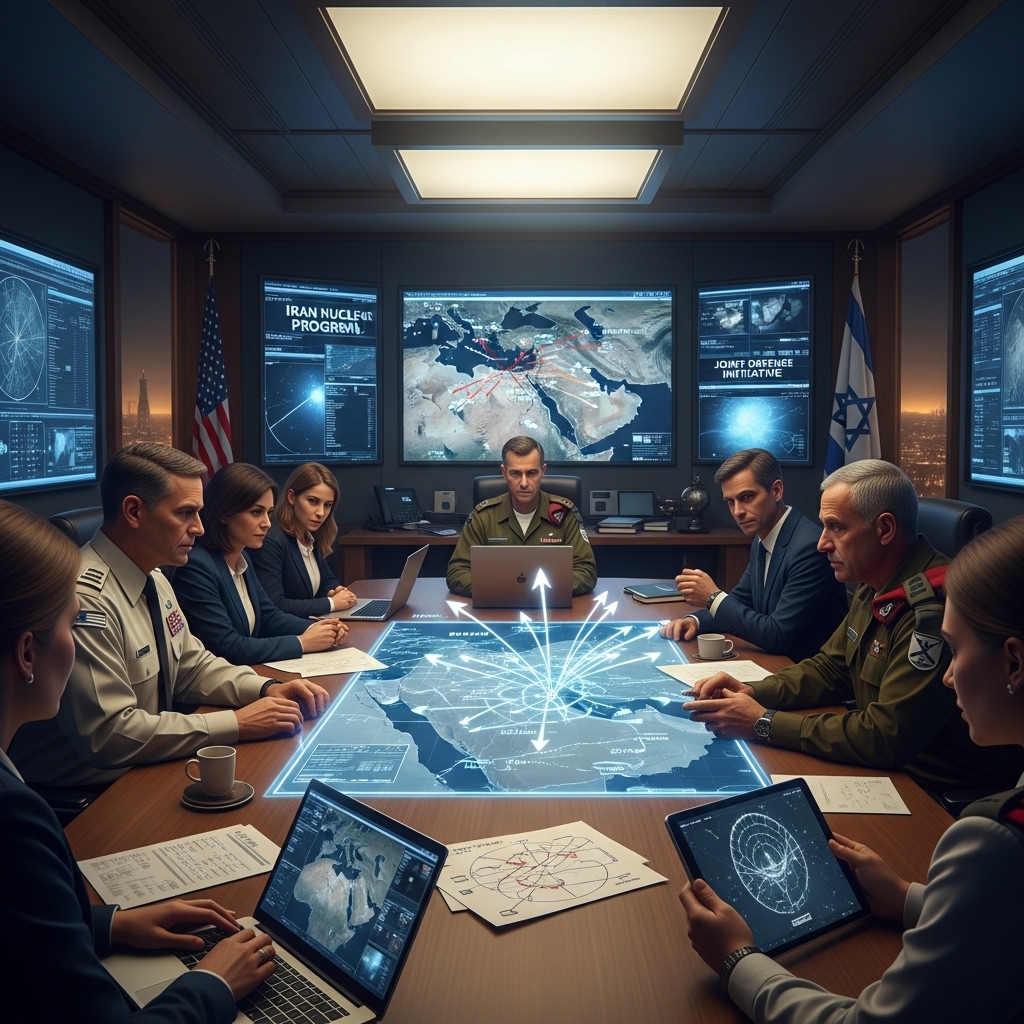
The ongoing military conflict with Iran, launched jointly by the United States and Israel, has been presented to the world as a necessary intervention to prevent nuclear proliferation and stabilize the Middle East but beneath this layer of security rhetoric lies a far more calculated and ambitious agenda. This war represents the final phase of an energy dominance strategy for Washington, first tested in Venezuela; a bid to control global oil reserves by seizing Iran’s vast petroleum wealth. Israel advances the decades-old Zionist dream of Greater Israel, an expansionist vision that extends from the Nile to the Euphrates and beyond. Understanding these true motives is essential not only for comprehending the current conflict but for anticipating the shape of the new Middle East being forged in fire.
It appears the United States did not arrive at war with Iran by accident or through diplomatic failure. The conflict represents the deliberate application of a regime change model perfected in Caracas just months earlier. In January 2026, US special forces captured Venezuelan President Nicolás Maduro in a lightning operation that installed Delcy Rodríguez as a compliant leader, granting Washington immediate access to Venezuela’s oil reserves. President Donald Trump openly celebrated this as “the perfect scenario”, a template he explicitly sought to replicate in Tehran. The logic is brutally simple: with control over Venezuelan oil, significant influence over Gulf Arab producers and now Iranian reserves, the US would effectively hold a monopoly over global energy supplies approximately 31 percent of the world’s proven reserves. This would give Washington unprecedented leverage over energy-hungry competitors like China, forcing Beijing to purchase American oil at market prices rather than discounted Iranian crude.
Operation Epic Fury mirrors that earlier intervention in both ambition and myopia. The same temptation that drove Eisenhower i.e., the lure of controlling one of the world’s largest oil reserves now drives Trump. America’s fixation on Iranian oil is not a Trump innovation but a return to foundational US foreign policy. In 1953, President Dwight Eisenhower authorized the CIA to overthrow Iran’s democratically elected Prime Minister Mohammad Mosaddegh after he nationalized the Anglo-Iranian Oil Company. The operation, code-named Ajax, restored the Shah to power and secured Western oil companies’ access to Iranian petroleum for decades at the cost of sowing the seeds for the 1979 Islamic Revolution.
If America’s motive is oil and energy dominance, Israel’s agenda is territorial expansion draped in theological language. The concept of Greater Israel has moved from fringe Zionist fantasy to official government policy, with US openly declaring Israel’s biblical right to land from the Nile River to the Euphrates, a territory encompassing not only Palestine but parts of Egypt, Jordan, Syria, Iraq and Saudi Arabia. This is not mere religious rhetoric but operational strategy. Prime Minister Benjamin Netanyahu has spent twenty years preparing for this moment, systematically eliminating regional obstacles to Israeli hegemony. The war on Iran represents the final chapter in a campaign that began with Iraq, continued through Libya, Syria and Yemen and finally targets the only remaining power capable of challenging Israeli dominance – Iran. The Greater Israel project operates through the term ‘encirclement and erasure’, a systematic campaign to dismantle any regional power that might resist Israeli expansion. Iran has long served as the backbone of the ‘Axis of Resistance’, supporting Hamas, Hezbollah and other groups that challenge Israeli occupation. Israel aims to leave itself surrounded only by weak, compliant states incapable of objection by decapitating Iran’s leadership and destroying its military infrastructure.
This also explains the timing of the attack, which occurred during the Islamic holy month of Ramzan, a period when warfare is traditionally prohibited. The choice was deliberately provocative, signaling that no norm, religious or international, will constrain the campaign. It also explains why several Muslim nations reportedly facilitated the strikes: fear of being the next target has transformed potential adversaries into collaborators, each hoping that helping the tiger attack their neighbor will spare them from becoming the tiger’s next meal.
The nuclear issue was a phantom used to justify the removal of a strategic counterweight. Crucially, both powers have relied on the nuclear threat as their primary justification for war, yet this rationale collapses under scrutiny. Before the conflict began, Iran was engaged in verified diplomatic negotiations through Omani backchannels, reportedly nearing a “Zero Enrichment” agreement that would have addressed international concerns.
The US-Israeli war on Iran represents a watershed moment in Middle Eastern history, not because it will achieve its stated goals, but because it reveals the true forces reshaping the region. America fights for oil and energy dominance, seeking to complete a global energy monopoly that would give it unprecedented leverage over rivals and allies alike. Israel fights for territorial expansion, pursuing a biblical vision of Greater Israel that extends from the Mediterranean to the Persian Gulf, encompassing the heart of the Arab world. Together, US and Israel have abandoned any pretense of international law, negotiated settlements, or diplomatic solutions. The rules-based order has been badly replaced by a “might-based order” however, for regional powers, the message is crystal clear: those who resist will be destroyed, while those who collaborate today may become tomorrow’s targets
The greatest danger, however, lies in the strategy’s internal contradictions. Air strikes alone do not produce regime change; they breed nationalist resistance. Seized oil resources do not guarantee energy dominance; they ignite regional conflagrations that disrupt global supplies. While Greater Israel cannot be built on the ashes of its neighbors without ensuring perpetual war. The US and Israel may have launched this conflict with dreams of oil wealth and territorial expansion, but they may find themselves trapped in the same quagmire that has swallowed every previous attempt to reshape the Middle East by force. In trying to seize Iran’s oil and realize Greater Israel, they may instead ignite a fire that consumes their ambitions entirely.

- The Hague Ruling on the Indus Waters Treaty - September 30, 2026
- Expansion of Makkah Joint Defence Agreement - September 30, 2026
- Significance of Multilateral Maritime Military Coalition - August 28, 2026