
Author Recent Posts Muammad Abubakar Nazar Latest posts by Muammad Abubakar Nazar (see all) U.S tariff relief and underlying complexities – August 28, 2025 ROLE OF EUROPE IN HUMANITARIAN CRISIS IN GAZA – August 20, 2025 Uncontrollable threat in Gilgit Baltistan – August 7, 2025
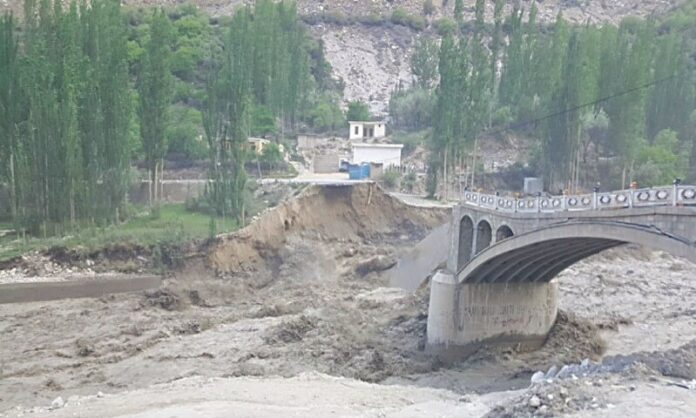
Glacial lake outburst floods (GLOFs) have become potential threat for the region of Gilgit Baltistan and government policies remain less effective to mitigate this eminent challenge. According to International Centre for Integrated Mountain Development (ICIMOD), a GLOF is sudden release of water from a lake fed by glacier melt that has formed at the side, in front, within, beneath, or on the surface of a glacier. Changing climate has made GLOF not only a problem that is rising substantially, in the North of Pakistan, but one that is hard to cope. There have been efforts by the government and local administration to control this GLOF threat but certain natural, geographical, administrative and socio-economic elements limit these struggles.
Geographical and topographical elements pose a challenge to effective control of GLOF threat. Gilgit Baltistan is a vast region with varying elevation of 3,000 ft. to 28,250 ft, in accordance with sea level, which makes it even more challenging to control natural disasters. Terrain of Gilgit Baltistan is also highly mountainous and natural flow of water due to gravity is uncontrollable. This further makes it extremely dangerous to build infrastructure, such as dams, in the region. Attabad Lake disaster of 2010 exemplifies the uncontrollable and dangerous geography of Gilgit Baltistan. A massive landslide in Attabad village of Hunza valley formed a natural dam on the river. This geographical disaster submerged villages, displaced over 6000 people, and completely cut off the Karakoram Highway, which is GB’s main route to connect with rest of the country. Authorities, in this regard, tried to drain the lake but faced challenge of surrounding mountain’s sheer height and instability. The government eventually relied on slow digging to ease lake’s pressure.
Global warming has made the issue of GLOFs more rapid and severe in the Northern Pakistan, specifically Gilgit Baltistan. The formation of ice in glaciers is a time taking process and requires certain low temperatures to become hard enough. The melting of this ice is a source of water for the rivers which flow off these glaciers. The formation and melting of ice are the processes which have to take place at a balanced rate, so that the equilibrium is maintained, but this is affected global warming. Rising temperatures in summer, due to global warming, cause ice to melt at a faster rate than other seasons. This melting ice often breaks a tidy sum of ice, blocking the route of water and causing the formation of a glacier lake. In 2022, the Shisper glacier underwent rapid melting due to increased temperature and it resulted in a glacial lake outburst flood near Hassanabad village in Hunza valley. This was second major GLOF in three years from the same glacier which is located in the Karakoram Range.
The governmental policies and efforts are very small as compared to the speedy formation of lakes on the verge of facing glacial lake outburst flooding. According to United Nations Development Program (UNDP) there are over 3000 lakes in the region of Gilgit Baltistan, and out of these almost 33 are at direct risk of GLOF. These numbers are staggering with each passing season, and other lakes are also prone to get under this threat category. Scaling-up of Glacial Lake Outburst Floods (GLOF-I) was a project launched by the government to control the prevailing disaster. This project aimed at securing vulnerable communities, establishing early warning automated systems, and building resilient infrastructure. The successor of GLOF-I, GLOF-II has already been launched which will also focus on further strengthening warning systems, infrastructure and other required actions. All these actions, done with the collaboration of UNDP, are much appreciated but less effective. The reason behind this is not only the geographical features of Gilgit Baltistan, but severe climate change is the main culprit. The global greenhouse gas emission contribution of Pakistan is less than 1% but it ranks among the top 10 most affected countries from climate change. This has caused Pakistan huge disasters including the recent floods of 2022 in which one-third of country submerged, displacing millions of people and causing billions of dollars in loss. In order to control GLOF threat effectively, international efforts are also required with addition to local actions.
The complete control of GLOF in Gilgit Baltistan may sound like a pipe dream rather than a reality. The focus should more be upon managing and adapting this threat in an efficient way. It can be related with the concept of arms limitation, which aims at limiting arms production rather than completely mitigating it, because that too is a pipe dream. Community-based awareness is also very necessary because the idea of risk-perception is below average in the region of Gilgit Baltistan. People should recognize these threats and only then some actual working politicies could be devised. Pakistan should also raise its concerns in the upcoming COP, calling upon international community to take more serious actions and demand for assistance in this matter.

- U.S tariff relief and underlying complexities - August 28, 2025
- ROLE OF EUROPE IN HUMANITARIAN CRISIS IN GAZA - August 20, 2025
- Uncontrollable threat in Gilgit Baltistan - August 7, 2025
















Leave a Comment
Your email address will not be published. Required fields are marked with *